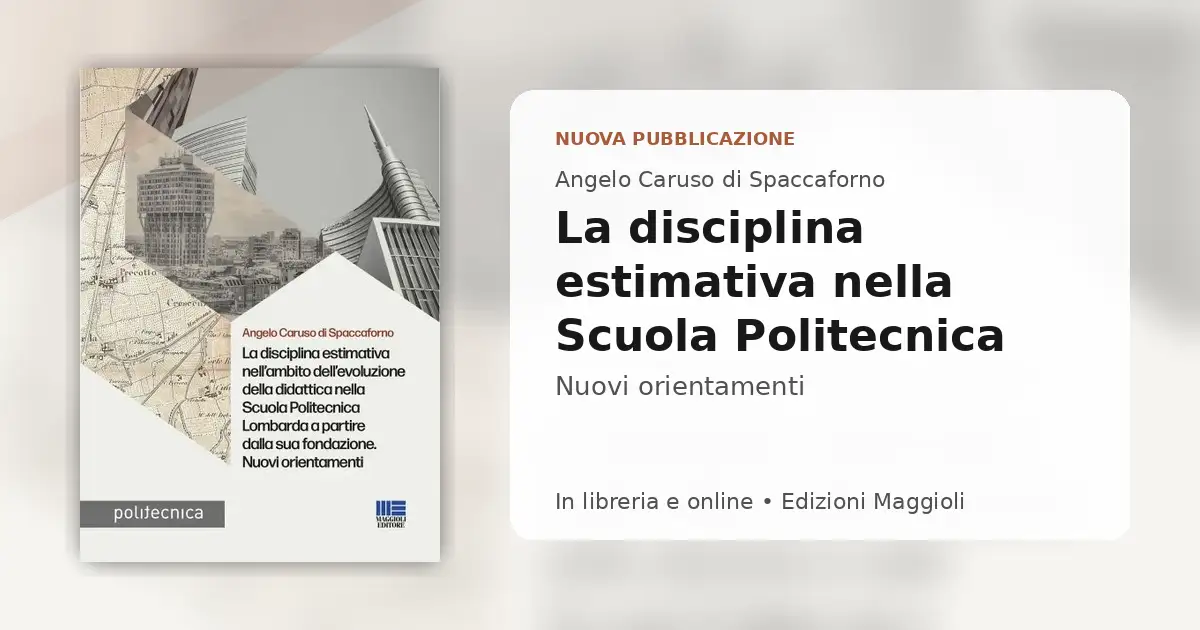
Maggioli publishes “La disciplina estimativa” by Angelo Caruso di Spaccaforno
A study on valuation education at Politecnico di Milano: socio-economic contexts, a comparison with Turin, and emerging professional profiles.
Maggioli Editore publishes (October 2020) “La disciplina estimativa nell'ambito dell'evoluzione della didattica nella Scuola Politecnica Lombarda a partire dalla sua fondazione. Nuovi orientamenti”, by Angelo Caruso di Spaccaforno.
The book retraces the evolution of valuation (estimo) education within the Lombard Polytechnic School, identifying the reasons that have shaped the discipline’s changing directions over time. Rather than offering a purely chronological account, the analysis links key shifts to broader socio-economic transformations and to the changing roles of the actors involved in urban and territorial development.
The study is presented through ten thematic chapters, designed to clarify what may appear as a fragmented trajectory and to highlight recent orientations: from the long phase in which agricultural land ownership was central, to more recent real-estate and finance-driven processes, and to the growing need for interdisciplinary and economic-financial approaches in project evaluation.
The volume also compares the Lombard and Piedmontese traditions, outlining similarities and differences between two major Italian valuation schools. It concludes by discussing emerging professional profiles (including the “Real Estate Valuer”, the “Value Manager” and the “PolisMaker”) and their implications for qualification and certification at national and international level.
Angelo Caruso di Spaccaforno is Associate Professor of Valuation and Economic Evaluation of Plans and Projects at Politecnico di Milano, and founder and director of the PolisMaker Master (“Il Polis Maker per la qualità del vivere e lo sviluppo urbano sostenibile”).
At a glance
- Published: October 2020 — Maggioli Editore.
- A reconstruction of valuation education at Politecnico di Milano, interpreted through socio-economic contexts.
- Organised into ten thematic chapters (not purely chronological) to clarify a seemingly fragmented evolution.
- Comparison with the Piedmontese Polytechnic tradition to highlight similarities and differences.
- Focus on emerging profiles: Real Estate Valuer, Value Manager, PolisMaker.
Useful links
For more information: polismaker@polimi.it